Before a patient ever sits in your waiting room, she has almost certainly already searched for answers online — about her symptoms, her options, and the doctor she's considering. Increasingly, she's searching on YouTube.
Women's health is one of the most privately researched, publicly under-discussed categories in medicine. Questions about irregular periods, PCOS, fertility, pregnancy symptoms, or menopause are rarely asked out loud before they're typed into a search bar — and video, more than any other format, is where patients go to find an answer they can actually trust and understand.
That shift creates a genuine opportunity for gynecologists, obstetricians, IVF specialists and women's health clinics: not to sell a service, but to educate the public on topics that are often surrounded by stigma, confusion or misinformation. Done well, this builds a level of trust that a website or a five-star review simply cannot replicate.
At AK Studios by Asfar Khan, we've worked directly with healthcare professionals in Islamabad and Rawalpindi to plan, film and manage educational YouTube content — including a documented case study with a private hospital's YouTube channel, covered in our Healthpoint YouTube case study. This guide brings that experience together into a single, comprehensive resource for gynecologists who want to build a YouTube presence the right way: educational first, ethical always, and structured for real, long-term growth.
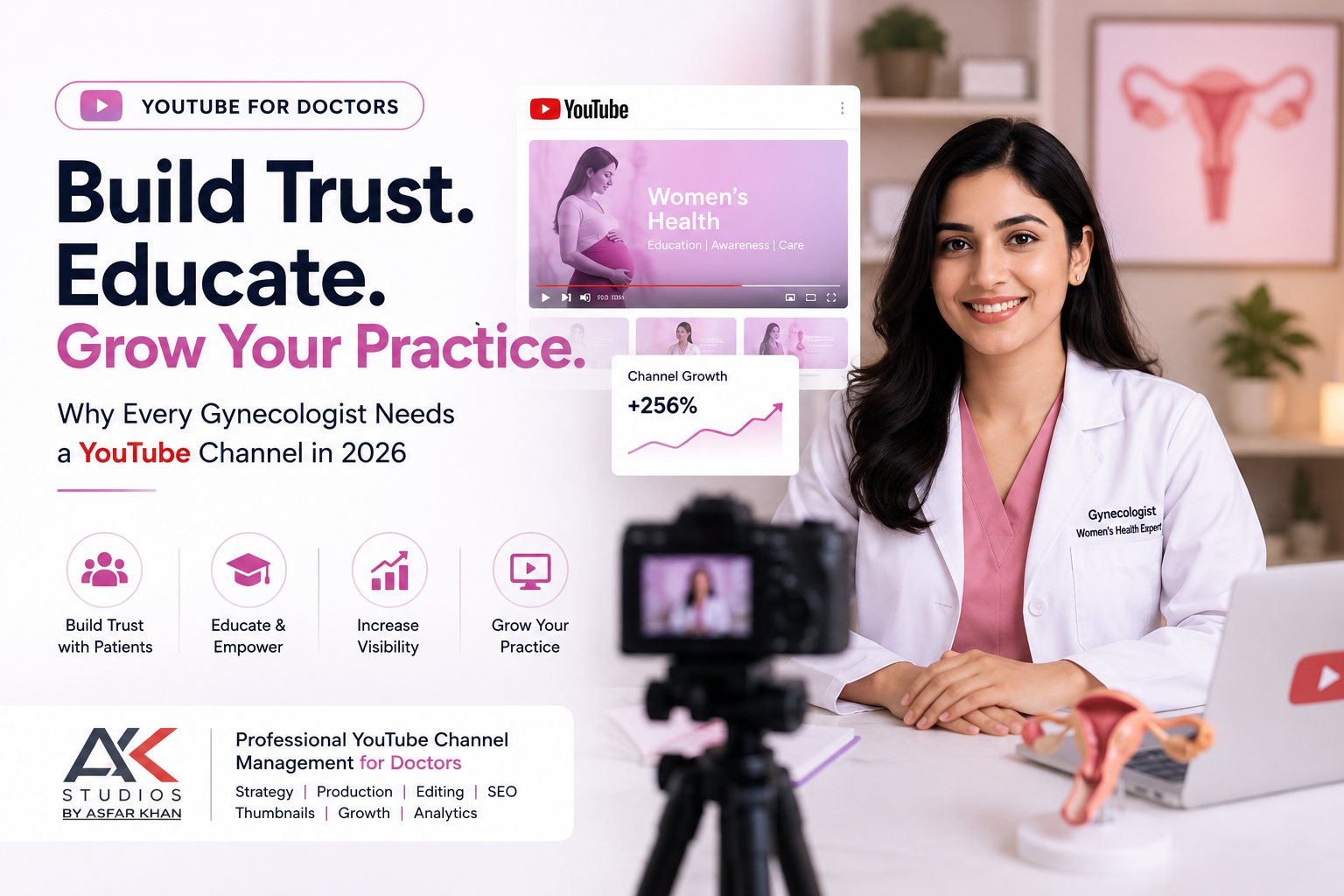
A professional YouTube presence turns patient education into lasting trust and practice growth
Table of Contents
- Why Patients Search YouTube Before Visiting a Doctor
- The Rise of Healthcare Content on YouTube
- Why Every Gynecologist Should Build a Personal Brand
- Benefits of a Professional YouTube Channel
- Increasing Google Visibility & Website SEO
- Growing Social Media Through YouTube
- Explaining Complex Topics & Reducing Patient Anxiety
- Core Women's Health Education Topics
- Building Long-Term Patient Relationships
- Ethical Medical Marketing & Council Guidelines
- Video Topics Every Gynecologist Should Cover
- Equipment, Studio vs Clinic Recording
- Editing Workflow
- YouTube SEO: Titles, Thumbnails & Keywords
- Shorts Strategy vs Long-Form Strategy
- Sample Monthly Content Calendar
- Common Mistakes Doctors Make
- AI in Healthcare Content Creation
- How AK Studios Manages Doctor YouTube Channels
- Why Choose AK Studios for YouTube Channel Management?
- Frequently Asked Questions
- Conclusion
Why Patients Search YouTube Before Visiting a Doctor
YouTube is widely regarded as the world's second-largest search engine, and health-related questions are among the most consistently searched topics on it. For women's health specifically, video has a distinct advantage over text: it can show, not just tell. A gynecologist explaining what a normal ultrasound scan looks like, or walking through what actually happens during a routine check-up, removes a layer of anxiety that a paragraph of text rarely can.
There's also a privacy dimension unique to this specialty. Many women feel more comfortable searching for information about PCOS, fertility or menstrual irregularities online — privately, at their own pace — than asking in person, even with a trusted doctor. A well-produced YouTube video meets that patient exactly where she already is: searching alone, before she's ready to book an appointment.
This means a gynecologist's YouTube channel isn't competing with the clinic visit. It's the step that happens before it — informing, reassuring, and often determining which doctor a patient eventually chooses to trust with an in-person consultation.
It's also worth understanding how patients actually behave once they start watching. Very few make a decision after a single video. More commonly, a patient will watch several videos from several different doctors on the same topic — comparing not just the information, but the tone, clarity and apparent patience of each one — before narrowing down who she wants to see in person. A channel that answers the same question thoroughly, calmly and without rushing has a real advantage in that comparison, even against doctors with a larger existing reputation offline.
The Rise of Healthcare Content on YouTube
Healthcare content has grown from a niche category into one of the platform's most actively developed areas. YouTube has taken visible steps to surface content from licensed health professionals and recognized organizations on sensitive health topics, and platforms like Google increasingly favor content that demonstrates real expertise and experience — the foundation of what Google calls E-E-A-T (Experience, Expertise, Authoritativeness, Trustworthiness) in its Search Central guidelines.
For gynecologists, this is a meaningful advantage. A licensed doctor speaking on camera about her own area of specialty carries a level of authority that generic health content simply cannot replicate — which is exactly the kind of signal search engines, and patients, are increasingly looking for.
This shift has also changed who patients trust as a source in the first place. A decade ago, most health information online came from unbranded articles with no clear author. Today, patients are increasingly skeptical of advice with no identifiable, qualified source behind it — and actively seek out content from a named, credentialed doctor instead. A consistent YouTube presence is one of the clearest ways for a gynecologist to be that identifiable, trusted source, rather than being outranked by generic, unauthored health content.
Why Every Gynecologist Should Build a Personal Brand
A clinic's reputation used to rest almost entirely on word of mouth and referrals. Today, a patient can watch a doctor speak, explain and answer questions before ever meeting her — which means the doctor's personal brand often does more to earn trust than the clinic's signage or website ever could.
A personal brand built on YouTube isn't about self-promotion. It's the accumulated impression left by dozens of videos that consistently demonstrate the same qualities: clarity, patience, up-to-date knowledge, and genuine care for patient understanding. Over time, that impression becomes the reason a patient chooses one gynecologist over another in a crowded market.
In competitive markets like Islamabad and Rawalpindi, where patients often have several qualified gynecologists to choose from within a short distance, this differentiation matters more than it might elsewhere. Clinical qualifications are, understandably, difficult for a patient to evaluate directly. What she can evaluate is how a doctor communicates — whether explanations feel rushed or unclear, or calm and genuinely patient-centered. A personal brand built through consistent video content is, in effect, a public demonstration of exactly that quality, long before the first appointment is booked.
Starting a Medical YouTube Channel — Checklist
- Define your niche and primary audience (e.g., pregnancy care, PCOS, fertility)
- Set up a branded channel with a professional banner, logo and channel description
- Write a short content mission statement to guide future topics
- Choose a consistent recording environment (studio or clinic corner)
- Plan your first eight video topics before filming the first one
- Set a realistic, sustainable upload frequency
- Review your medical council's advertising and social media guidelines
- Prepare a simple consent process for any patient-adjacent footage
Benefits of a Professional YouTube Channel
A well-run YouTube channel does several jobs at once — jobs that would otherwise require separate marketing efforts entirely.
Patient Education
Videos explain conditions and procedures in plain language, reducing confusion before and after appointments.
Building Trust
Seeing and hearing a doctor speak builds familiarity and credibility that text alone cannot achieve.
Improving Online Reputation
A library of thoughtful, accurate videos becomes a public reflection of the doctor's expertise and care.
Becoming an Authority
Consistent, specialty-specific content positions a gynecologist as a go-to voice in her field over time.
| Organic YouTube Content | Paid Advertising | |
|---|---|---|
| Cost over time | Lower long-term; upfront production cost | Ongoing spend required to sustain reach |
| Trust factor | Higher — feels like education | Lower — recognized as an advertisement |
| Longevity | Videos keep working for years | Stops the moment budget stops |
| Best use | Building authority and patient education | Promoting a specific event or offer |
| Ideal role | Primary, long-term strategy | Occasional, targeted supplement |
Increasing Google Visibility & Website SEO
YouTube videos can appear directly within Google search results, sometimes above standard web pages, especially for question-based searches like "what is PCOS" or "signs of pregnancy." This gives a gynecologist two separate opportunities to appear in front of the same searching patient — once through the clinic website, and again through video.
Embedding YouTube videos on a clinic's website also improves the website itself: it increases the time visitors spend on the page, adds fresh, relevant content that search engines can index, and gives patients a reason to explore beyond a single page. This same video content, shared to a Google Business Profile as a regular post, can also strengthen how the clinic appears in local search and map results.
| Factor | Clinic Website | YouTube Channel |
|---|---|---|
| Primary purpose | Information & booking | Education & discovery |
| Search visibility | Google web search only | Google search + YouTube's own search engine |
| Content format | Static text and images | Video — the format patients trust most for explanation |
| Update frequency | Occasional | Weekly, which keeps the channel active in recommendations |
| Patient relationship | Largely one-way | Builds familiarity before the first visit |
| Best combined with | Embedded YouTube videos | A website link in every video description |
Growing Social Media Through YouTube
A single well-planned YouTube video rarely stays on YouTube alone. It can be trimmed into Instagram Reels, Facebook videos, and TikTok clips, giving a clinic weeks of social content from a single recording session. This is far more efficient than trying to produce original short-form content for every platform separately.
| Factor | YouTube | |
|---|---|---|
| Content lifespan | Short — buried in the feed within days | Long — videos remain searchable for years |
| Discovery method | Algorithm-fed feed | Active search plus suggested videos |
| Best content type | Quick updates, community posts | In-depth education, explainer videos |
| SEO value | Limited visibility in Google search | Strong — videos can rank directly in Google search results |
| Repurposing role | Hosts clips repurposed from YouTube | The original, long-form home for the content |
Explaining Complex Topics & Reducing Patient Anxiety
Medical terminology is often the biggest barrier between a doctor and a worried patient. A video that calmly explains what a diagnosis actually means, in everyday language, can measurably reduce the anxiety a patient feels walking into an appointment — because she already understands, in general terms, what to expect.
A recurring "Frequently Asked Questions" video series is one of the most effective formats for this. Gynecologists already hear the same handful of questions from patients every week — turning those into short, dedicated videos means every future patient gets a clear answer before she even asks.
Core Women's Health Education Topics
Some subjects consistently generate the most patient interest and search demand, because they combine high emotional relevance with genuine confusion or stigma. These are strong foundations for any gynecology channel.
Pregnancy Education
- First trimester expectations
- Nutrition & safe exercise
- Warning signs to watch for
- Normal delivery vs C-section
- Postpartum recovery basics
PCOS Education
- Common symptoms explained
- Diagnosis process overview
- Lifestyle & treatment options
- Myths vs facts
- When to seek evaluation
Fertility Awareness
- Understanding your cycle
- When to consider evaluation
- General IVF process overview
- Lifestyle factors
- Common misconceptions
Menopause Education
- Perimenopause signs
- Managing common symptoms
- Bone & heart health
- Hormone therapy overview
- When to consult a doctor
Women's Health Awareness
- Routine screening importance
- Menstrual health basics
- Breast health awareness
- Preventive check-up guidance
- General wellness habits
Every topic here should be framed as general education — explaining what a condition is and when to seek care — rather than diagnosing or treating any individual viewer through the video itself.
Building Long-Term Patient Relationships
A single video rarely converts a viewer into a patient. What builds a relationship is the accumulation of dozens of videos over months and years — a body of work that shows a doctor is consistent, current, and genuinely invested in patient understanding, not just visibility for its own sake.
This compounding effect is what separates a channel that plateaus after a handful of videos from one that becomes a real community resource. Patients begin recommending the channel itself, not just the doctor — sharing a specific video with a friend or family member who's asking the same question they once had.
There's also a quieter, longer-term benefit that's easy to underestimate: existing patients keep watching too. A patient who has already had her first consultation, and then finds a follow-up video answering the exact question she forgot to ask in the room, walks away with more confidence in her care — and is more likely to return for future visits and refer others. Community trust of this kind isn't built by a single viral video; it's built by a channel a patient can rely on being there, consistently, whenever she has a question.
Ethical Medical Marketing & Council Guidelines
Healthcare marketing carries a higher standard of responsibility than most other industries, and for good reason. Every gynecologist building a YouTube presence should keep a small set of principles at the center of every video:
- Never guarantee a specific medical outcome
- Never share identifiable patient information without documented, informed consent
- Clearly frame content as general education, not individual diagnosis
- Avoid disparaging other doctors, clinics or treatment approaches
- Disclose sponsorships or paid partnerships transparently
- Encourage viewers with personal concerns to book a real consultation
These principles align broadly with the advertising and professional conduct standards published by regulatory bodies such as the Pakistan Medical & Dental Council and international guidance from organizations like the World Health Organization, ACOG and FIGO. Requirements vary by country and specialty, so it's always worth confirming current guidance with your own regulatory body before publishing.
| Educational Video | Promotional Video | |
|---|---|---|
| Goal | Inform and empower patients | Promote a specific service or offer |
| Typical response | Trust, shares, return viewers | Skepticism if overused |
| Ethical risk | Low, when medically accurate | Higher — requires care around claims |
| YouTube performance | Tends to perform better long-term | Often limited reach and engagement |
| Recommended balance | The large majority of content | Used sparingly, framed transparently |
Video Topics Every Gynecologist Should Cover
Beyond the core women's health categories above, these realistic video formats consistently perform well without ever compromising patient privacy.
PCOS Explained
A calm, structured overview of symptoms, causes and when to seek evaluation.
Pregnancy Nutrition Basics
General dietary guidance for a healthy pregnancy, in plain language.
Infertility Awareness
General education on when and why to consider a fertility evaluation.
C-Section Recovery
A general recovery timeline and what to expect in the weeks after surgery.
Menopause Awareness
Common symptoms and general management approaches explained clearly.
Breastfeeding Education
Practical, general guidance for new mothers in the first weeks.
Routine Check-Up Guidance
What actually happens during a standard visit, to reduce first-visit anxiety.
Doctor Q&A Sessions
Answering the most common patient questions in one dedicated format.
Clinic Introduction
A short walkthrough of the clinic and team to build familiarity before a visit.
Patient Education Animations
Simple animated explainers for anatomy or procedures, without any patient footage.
None of these formats require showing an identifiable patient or sharing private case details — every example above can be produced using general explanation, graphics, or the doctor speaking directly to camera.
Equipment, Studio vs Clinic Recording
Production quality matters, but it matters far less than clarity of audio and consistency of upload. A well-lit smartphone video with clean sound will always outperform a cinematic video that's inconsistent or hard to hear.
Camera
A modern smartphone or an entry-level mirrorless camera (such as a Sony ZV or Canon R-series) is sufficient to begin professionally.
Audio
A lavalier or shotgun microphone matters more than any camera upgrade — clear sound is the single biggest factor in whether a viewer stays.
Lighting
A simple two-point softbox or LED panel setup removes harsh shadows and makes the doctor easier to watch for longer.
| Studio Recording | Clinic Recording | |
|---|---|---|
| Environment control | Full control of light and sound | Variable; requires setup each session |
| Background | Clean, branded backdrop | Real clinic setting builds authenticity |
| Best for | Scripted explainers, Q&A sessions | Clinic tours, general procedure walkthroughs |
| Setup time | One-time setup, reused each time | Requires setup and breakdown per session |
| Privacy considerations | Minimal | Requires clear boundaries to protect patient privacy |
Equipment Checklist
- Camera or modern smartphone with good video quality
- External microphone (lavalier or shotgun)
- Tripod or basic stabilizer
- Key light plus a fill light, or a quality ring light
- Clean, uncluttered backdrop or dedicated recording corner
- Spare batteries and storage cards
- A simple teleprompter app for longer scripts (optional)
Clinic Recording Checklist
- Confirm no identifiable patients are visible without documented consent
- Silence phones and clinic notification sounds
- Test audio levels before recording the full take
- Check lighting for harsh shadows on the face
- Clear the background of clutter or conflicting branding
- Record a few seconds of room tone for the editor
- Do a short test clip before recording the full video
Editing Workflow
A consistent editing workflow is what turns raw footage into a video patients actually finish watching. A practical sequence looks like this: rough cut for pacing and clarity, removal of filler words and dead air, addition of simple text callouts for key terms, light color correction for a clean, professional look, background music at a low, unobtrusive level, and accurate captions added before publishing — since a large share of viewers watch with sound off.
A consistent intro and outro — even something as simple as a five-second branded title card and a closing frame with the clinic's contact details — helps a channel feel like a cohesive series rather than a set of disconnected uploads, which matters for both viewer trust and channel recognition over time. Text callouts deserve particular care on a medical channel: defining an unfamiliar term the moment it's said on screen (for example, showing "PCOS = Polycystic Ovary Syndrome" as a caption) measurably reduces confusion without requiring the doctor to stop and explain every acronym mid-sentence.
For a deeper breakdown of adjustment-by-adjustment editing technique, see our companion guide, The Ultimate Photography Editing Workflow, which covers many of the same color and pacing principles used in medical video editing.
YouTube SEO: Titles, Thumbnails & Keywords
YouTube is a search engine first and a social platform second. Optimizing for search means writing titles and descriptions the way patients actually search — not the way a textbook would phrase the same topic.
Titles
Use the exact phrase a patient would type, such as "PCOS Symptoms Explained" rather than a clinical heading.
Thumbnails
A clear photo of the doctor's face plus 3-5 words of large, readable text consistently outperforms decorative designs.
Descriptions
The first two lines matter most for search — include the core keyword naturally within the first sentence.
Keywords & Tags
Research the specific phrases patients search using YouTube's own autocomplete suggestions as a free starting point.
YouTube Analytics (available in every channel's Studio dashboard) shows which topics actually hold viewer attention, where viewers drop off, and which traffic sources are driving views — data that should directly shape future content decisions rather than being reviewed once and forgotten. Full documentation is available through YouTube's official Help Center and the YouTube Creator Academy.
YouTube SEO Checklist
- Keyword-researched, patient-language title
- Custom thumbnail with a clear face and readable text
- Keyword-rich description, front-loaded in the first two lines
- Relevant tags added
- Video added to the correct topic-based playlist
- End screen linking to a related video
- Pinned comment summarizing the key takeaway
- Captions reviewed for accuracy before publishing
Shorts Strategy vs Long-Form Strategy
Shorts and long-form videos serve different jobs in the same strategy — one drives discovery, the other builds depth and trust.
| YouTube Shorts | Long-Form Videos | |
|---|---|---|
| Length | Under 60 seconds | 6–12+ minutes |
| Discovery | Shown widely via the Shorts shelf | Found through search and suggested videos |
| Best for | Quick tips, myth-busting, teasers | In-depth education and detailed explainers |
| Watch behavior | High volume, lower depth per view | Lower volume, higher trust-building per view |
| Realistic frequency | 2–3 per week | 1 per week |
| Role in strategy | Top-of-funnel awareness | Core trust-building content |
Sample Monthly Content Calendar
Consistency is easier to sustain with a simple plan mapped out in advance, rather than deciding what to film each week from scratch.
| Week | Long-Form Video | Shorts (2-3) | Notes |
|---|---|---|---|
| Week 1 | Understanding PCOS: Symptoms & When to See a Doctor | Myth-busting clips from the video | Evergreen topic |
| Week 2 | What to Expect at Your First Prenatal Visit | Common first-visit questions answered | Pairs well with a clinic tour Short |
| Week 3 | C-Section Recovery: A General Guide | Quick recovery tips | High search demand, evergreen |
| Week 4 | Menopause: Common Questions Answered | Doctor Q&A highlight clips | Aligns with awareness-month campaigns where relevant |
Content Planning Checklist
- One core educational topic planned per week
- A mix of evergreen and seasonal or awareness-linked topics
- 3-5 Shorts planned per long-form video
- Relevant awareness-month topics mapped in advance
- Patient FAQ list reviewed monthly for fresh video ideas
- Analytics reviewed before planning the following month
Common Mistakes Doctors Make
- Using dense medical terminology without plain-language explanation
- Uploading in bursts, then disappearing for months
- Ignoring audio quality in favor of visuals
- Writing clickbait titles that don't match the actual content
- Responding to individual symptoms in public comments
- Treating every video as a promotional opportunity instead of an educational one
AI in Healthcare Content Creation
AI tools now play a genuinely useful, supporting role in medical content production — generating first-draft captions, suggesting thumbnail text variations, assisting with rough-cut editing, and speeding up transcription for accessibility. Used this way, AI accelerates the technical, repetitive parts of production.
Accessibility is one of the more underrated applications. AI-generated captions and simple multi-language subtitle drafts (Urdu, English, or both) make a single video usable by a much wider range of patients, including those who watch with sound off in a waiting room or a shared household. AI can also speed up early-stage thumbnail testing, generating several text-and-layout variations for a human to choose between, and help summarize long viewer comment threads into a shortlist of the questions patients are actually asking most — a useful, low-effort input for planning future videos.
What AI should never do on a medical channel is generate medical claims, symptoms lists, or treatment information on a doctor's behalf. Every fact stated in a video should be reviewed and approved by the doctor herself before publishing — AI can help produce the video faster, but it cannot replace clinical judgment or accountability for what's said on camera. The same caution applies to AI-generated voices or avatars: patients are trusting a real, identifiable doctor, and that trust depends on what they see and hear actually being her.
How AK Studios Manages Doctor YouTube Channels
Running a consistent, high-quality YouTube channel alongside a full patient schedule is genuinely difficult without dedicated support. This is the structured process AK Studios follows for healthcare clients, from first strategy call to monthly reporting.
Strategy & Channel Audit
We start by understanding the doctor's specialty focus, existing patient questions, and current online presence, then build a content strategy around what patients are actually searching for.
Script Writing
Every video starts with a clear, plain-language script reviewed and approved by the doctor, ensuring medical accuracy stays entirely in the doctor's control.
Filming
We film on location at the clinic or in a studio-style setup, handling all camera, audio and lighting logistics so the doctor only needs to focus on delivery.
Editing & Motion Graphics
Cinematic editing, color grading, and simple motion graphics for key terms and statistics make each video easier to follow and more professional to watch.
Thumbnail Design
Custom thumbnails are designed for clarity and click-through, without resorting to misleading or sensationalized imagery.
SEO Optimization
Titles, descriptions, tags and playlists are optimized around the real language patients search, based on keyword research specific to the doctor's specialty.
Upload & Publishing Management
We manage the full upload process and publishing schedule, so videos go out consistently even during the doctor's busiest clinical weeks.
Channel & Analytics Monitoring
We track subscriber growth, watch time, and traffic sources on an ongoing basis to understand what's genuinely resonating with viewers.
Monthly Growth Reporting
A monthly report summarizes performance in plain terms — what grew, what worked, and what the next month's content plan should prioritize.
| DIY (Doctor-Managed) | Professional Management | |
|---|---|---|
| Time investment | High — competes directly with patient care | Minimal — doctor focuses on filming only |
| Production quality | Variable, dependent on available time | Consistent, professional standard |
| SEO & metadata | Often overlooked | Optimized on every upload |
| Consistency | Frequently inconsistent | Structured, planned content calendar |
| Analytics & strategy | Rarely reviewed in depth | Monitored monthly with reporting |
| Growth trajectory | Slower, often plateaus early | Structured and built to compound over time |
Why Choose AK Studios for YouTube Channel Management?
AK Studios provides complete YouTube channel management built specifically around the realities of a medical practice — where the doctor's time is the scarcest resource, and accuracy can never be compromised for speed. Rather than treating a doctor's channel like any other business page, we build a process around medical content planning, ethical guardrails, and a production standard that reflects the trust patients are being asked to place in it.
Our services for healthcare professionals include:
We don't promise a specific number of views, subscribers or patients — no honest agency can. What we do promise is a consistent, professional, ethically produced channel, run by people who understand both video production and the particular responsibilities that come with healthcare content. Our documented work with a private hospital's YouTube channel in the Healthpoint case study reflects that same approach in practice.
Frequently Asked Questions
Should gynecologists have a YouTube channel?
Yes, when used for patient education rather than direct promotion. A YouTube channel lets a gynecologist answer common patient questions, explain conditions like PCOS or menopause in plain language, and build trust with women who are researching their health online before ever booking an appointment.
Can gynecologists advertise on YouTube?
Gynecologists can maintain a YouTube presence, but any advertising or promotional content should follow the advertising guidelines of their national medical council or regulatory body. Educational content that informs rather than sells is generally the safer, more effective, and more sustainable long-term approach.
What videos should a gynecologist upload?
Strong starting topics include general PCOS education, pregnancy nutrition basics, what to expect at a first prenatal visit, menopause changes, fertility awareness, breastfeeding basics, and answers to frequently asked patient questions — all presented as general education, not individual diagnosis.
How often should doctors post on YouTube?
One well-produced long-form educational video per week, supported by two to three YouTube Shorts, is a realistic and sustainable pace for most practices. Consistency over time matters more than posting frequency alone.
Does YouTube help attract patients?
A consistent, educational YouTube channel can increase a practice's visibility, build familiarity before a first visit, and support a clinic's overall online presence. Results vary by market and consistency, and YouTube should be treated as a trust-building channel rather than a guaranteed patient-generation tool.
How long should medical education videos be?
Six to twelve minutes is a practical range for a single-topic explainer that goes deep enough to be genuinely useful without losing viewer attention. YouTube Shorts under 60 seconds work well for quick tips, myth-busting, and teasers that point viewers to the full video.
Is it safe for doctors to share medical information on YouTube?
Yes, when the content is general health education rather than a diagnosis for a specific person. Clear disclaimers that videos are for educational purposes only, and that viewers should consult their own doctor for personal concerns, are standard practice on medical YouTube channels.
Do gynecologists need to show patients in their videos?
No. The most effective and lowest-risk medical YouTube channels rarely feature identifiable patients, and never without clear, documented consent. Explainer-style videos, Q&A sessions, and clinic introductions can all be produced effectively without patient footage.
What equipment does a gynecologist need to start a YouTube channel?
A modern smartphone or entry-level mirrorless camera, an external microphone, and a simple two-point lighting setup are enough to start. Clear audio and steady, well-lit video matter far more than expensive gear when a channel is just beginning.
Should I record videos in my clinic or a studio?
Both have a role. A quiet studio-style setup works well for scripted explainer videos and Q&A sessions, while clinic recording — such as a clinic tour or general procedure walkthrough — can build authenticity, as long as patient privacy is fully protected.
What language should gynecologists use for their videos?
The language your patients understand best. In Pakistan, many successful medical channels use Urdu, English, or a natural mix of both, since the goal is clear communication rather than formality.
How do I make my medical videos appear in Google search results?
Use the specific phrases patients actually search for in your titles and descriptions, embed your videos on your clinic website, write accurate closed captions, and organize videos into topic-based playlists. YouTube videos can and do appear directly in Google search results alongside standard web pages.
Can YouTube Shorts help a medical channel grow faster?
Shorts are a strong discovery tool because they're shown to a wide audience beyond a channel's existing subscribers, but they work best as a supplement that drives viewers toward the long-form videos where deeper trust and education actually happen.
Is it ethical for doctors to answer patient questions in video comments?
General educational replies are fine, but responding to a specific person's symptoms or offering an individual diagnosis in public comments is not appropriate. The safer, standard practice is to keep comment replies general and direct anyone with a personal concern to book a proper consultation.
How do I measure if my YouTube channel is actually working?
Track subscriber growth, average view duration, click-throughs to your website or WhatsApp, growth in branded search for your name or clinic, and how often new patients mention having seen your videos. Views alone are the least useful metric — engagement and downstream actions matter more.
What's the biggest mistake doctors make on YouTube?
Inconsistency is the most common mistake — publishing a burst of videos and then going quiet for months. Using dense medical terminology without plain-language explanation is a close second, since it undermines the accessibility that makes video education valuable in the first place.
Do I need a professional editor, or can I edit my own videos?
Editing your own videos is possible when starting out, but as a channel grows, professional editing, thumbnail design and SEO optimization save significant time and produce a more consistent, trustworthy result — which is where a dedicated YouTube management partner becomes valuable.
How does AK Studios help gynecologists specifically?
AK Studios provides end-to-end YouTube channel management for gynecologists and other healthcare professionals — strategy, script writing, filming, cinematic editing, thumbnail design, SEO, upload management, and monthly growth reporting — built around ethical, patient-education-first content rather than promotional messaging.
Conclusion
Patients researching women's health topics are already on YouTube, searching for answers, comfort and clarity — often before they've told anyone they're looking. A gynecologist who shows up in that moment, with clear, accurate, genuinely helpful education, builds a form of trust that no amount of traditional advertising can replicate.
Getting there consistently — good scripts, clean audio, thoughtful SEO, a realistic content calendar, and a workflow that doesn't collapse the moment clinic schedules get busy — is where most doctors run out of time, not ideas. That's the gap a structured YouTube management partnership is built to close.
Build a YouTube Channel That Educates, Builds Trust and Grows With You
AK Studios by Asfar Khan provides complete YouTube channel management for gynecologists and other healthcare professionals — strategy, video production, editing, motion graphics, thumbnail design, SEO, content planning, upload management, analytics, Shorts, branding and YouTube growth consulting, all in one partnership.